
Case Study
MKController vs. Wirenexfree for WISPs
How MKController and Wirenexfree compare for WISPs: hotspot vouchers vs. centralized operations, and the PPPoE path forward.
Summary Wirenexfree and MKController solve different problems for WISPs at different stages. Wirenexfree is a focused hotspot-voucher tool — useful as an entry point for operators who need to monetize access fast with minimal setup. MKController is a broader operational platform, designed for WISPs that have outgrown voucher-only logic and need centralized device management, role-based access, subscriber continuity, and a roadmap toward PPPoE and recurring service plans.
What should be on every WISP’s evaluation radar?
Every WISP eventually looks at platforms through the same four-question filter. Does this tool help me sell access today? Does it reduce support work as I scale? Does it fit how my network and business are evolving together? Does it leave me with a path forward when my needs change, or will I have to rip-and-replace in two years?
This is the lens to use when comparing Wirenexfree and MKController. It is not a feature fight between two product pages — it is a question about WISP maturity. A solution that works perfectly at twenty hotspot users may not be the right answer for an operator that grows into two hundred recurring subscribers with mixed PPPoE and hotspot delivery models.
What Wirenexfree does well
Wirenexfree is well-positioned as a hotspot-voucher tool for operators that need a quick way to monetize access. The voucher model is easy to understand, easy to sell, and easy to operate without specialized staff. It works for hotspot environments, prepaid usage, temporary access in events or hospitality, guest networks, and small community deployments — exactly the contexts where simplicity is the feature.
Many WISPs and local providers start with this kind of need. They are not looking for a full OSS/BSS on day one. They want something that helps them launch, validate demand, and start producing revenue without a heavy implementation project. From that perspective, Wirenexfree is a sensible entry-point tool, and it fills its niche cleanly.
Where the WISP radar gets wider
The challenge is that WISPs rarely stay in entry-point mode for long. As the customer base grows, the operational questions get harder: how do you keep configuration consistent across multiple sites? How do you organize permissions for different staff roles? How do you centralize visibility across routers, switches, and access points? How do you reduce manual provisioning? How do you transition from temporary session sales to recurring subscriber plans?
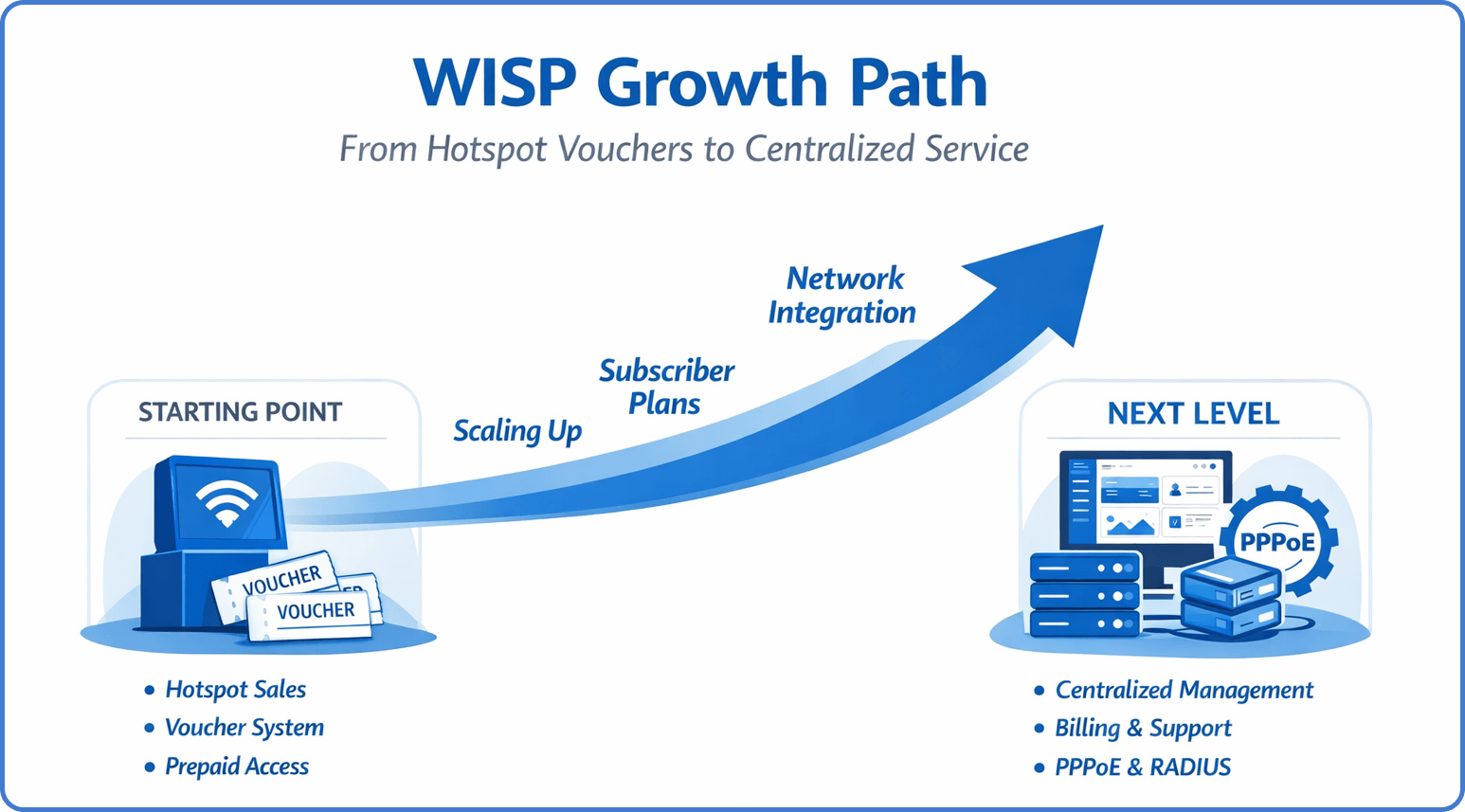
This is the inflection point where the platform choice starts to matter strategically. Voucher-only tools can illustrate the first stage well — simple monetization, basic access control, low barrier to entry. MKController starts to illustrate the next stage: broader fleet management, role-based access for staff, deeper visibility across devices, and structured workflows that scale with the business.
Why hotspot monetization isn’t the whole operation
Voucher systems solve a real problem. They package internet access in a way that’s easy to sell and easy to consume. For hotspot-based business models, they remain relevant — practical, fast to deploy, and approachable for non-technical teams. The limitation isn’t the tool; it’s that a maturing WISP eventually needs more than session-based monetization.
A WISP at scale needs customer continuity, recurring service logic, and stronger linkage between user identity, service plan, authentication, support, and billing. It needs network operations and business operations to stop behaving like separate worlds. That’s where the idea of a “WISP radar” becomes useful — a smart operator doesn’t only ask what solves today’s problem, but also what prepares the business for next year’s reality.
For broader operational context, see our companion guide on remote MikroTik management via VPS and the SNMP monitoring tutorial for fleet visibility.
Wirenexfree as a starting point, MKController as an evolution
This is the cleanest way to frame the comparison. Wirenexfree fits operators who want to launch hotspot monetization quickly — it belongs to a category of tools that remove friction at the beginning of a WISP’s life. They are approachable, direct, and matched to simple deployment models.
MKController looks more like the platform an operator grows into. It places monetization inside a wider management context — centralization, operational visibility, administrative structure, and the ability to assemble a more complete service environment over time. For a WISP, that difference matters because nobody wants to rebuild the operation from scratch eighteen months in.
Why PPPoE changes the conversation
One of the clearest markers of a maturing WISP is the shift from temporary access logic to subscriber logic, and PPPoE is the protocol that carries that shift. PPPoE is not just a technical detail — it reflects a different operating model. Instead of selling isolated sessions, the operator manages recurring services, stable subscriber authentication, structured service plans, and closer alignment between the customer database and the network database.
To be transparent: MKController’s PPPoE capability is on the active roadmap, not fully delivered today. The direction makes strategic sense precisely because MKController is already broader than vouchers. A WISP adopting MKController today is not just choosing a way to monetize access — it’s moving toward a structure that consolidates the wider set of capabilities a WISP needs as it grows.
Why “one place” matters
WISPs almost always grow faster than their internal tools do. Early on, the patchwork is manageable: a router here, a spreadsheet there, a billing workaround somewhere else, a hotspot tool filling one specific gap. For a while, it works. Then the cracks appear — staff spend time moving between systems, information gets duplicated, provisioning becomes inconsistent, support takes longer than it should, and scaling becomes more tiring than exciting.
Platform consolidation is the answer. MKController presents a stronger long-term vision because it is closer to the idea of a single operational environment. Even before the full PPPoE capability ships, the underlying logic is already there: bring important workflows together, reduce fragmentation, and give the operator a clearer management layer.
A practical way to read this comparison
For a WISP that needs straightforward hotspot monetization with low complexity today, Wirenexfree is a sensible starting point. It is a practical entry into access sales and can help validate a first-stage business model.
For a WISP looking beyond the first stage — one that wants centralized operations, structured staff roles, fleet-wide configuration management, and a credible path to subscriber plans — MKController is the more interesting choice. The two tools are not really in the same fight; they represent different stages of WISP maturity, and the right answer depends on where you are in that journey today and where you intend to be in eighteen months.
Take the next step
If you’ve outgrown voucher-only logic — or you can see the moment coming — start evaluating the platforms that handle the broader operation. MKController gives you centralized device management, role-based staff access, configuration history, fleet-wide monitoring, and a roadmap toward recurring service plans without forcing you to rebuild what you’ve already shipped.