
WISP Growth Radar: Wirenexfree and MKController
Este conteúdo não está disponível em sua língua ainda.
Summary
Every WISP starts somewhere. Tools like Wirenexfree can help operators begin with simple hotspot monetization, while MKController represents the next step for those planning broader control, centralized operations, and a future-ready service platform.
WISP Growth Radar: Wirenexfree and MKController
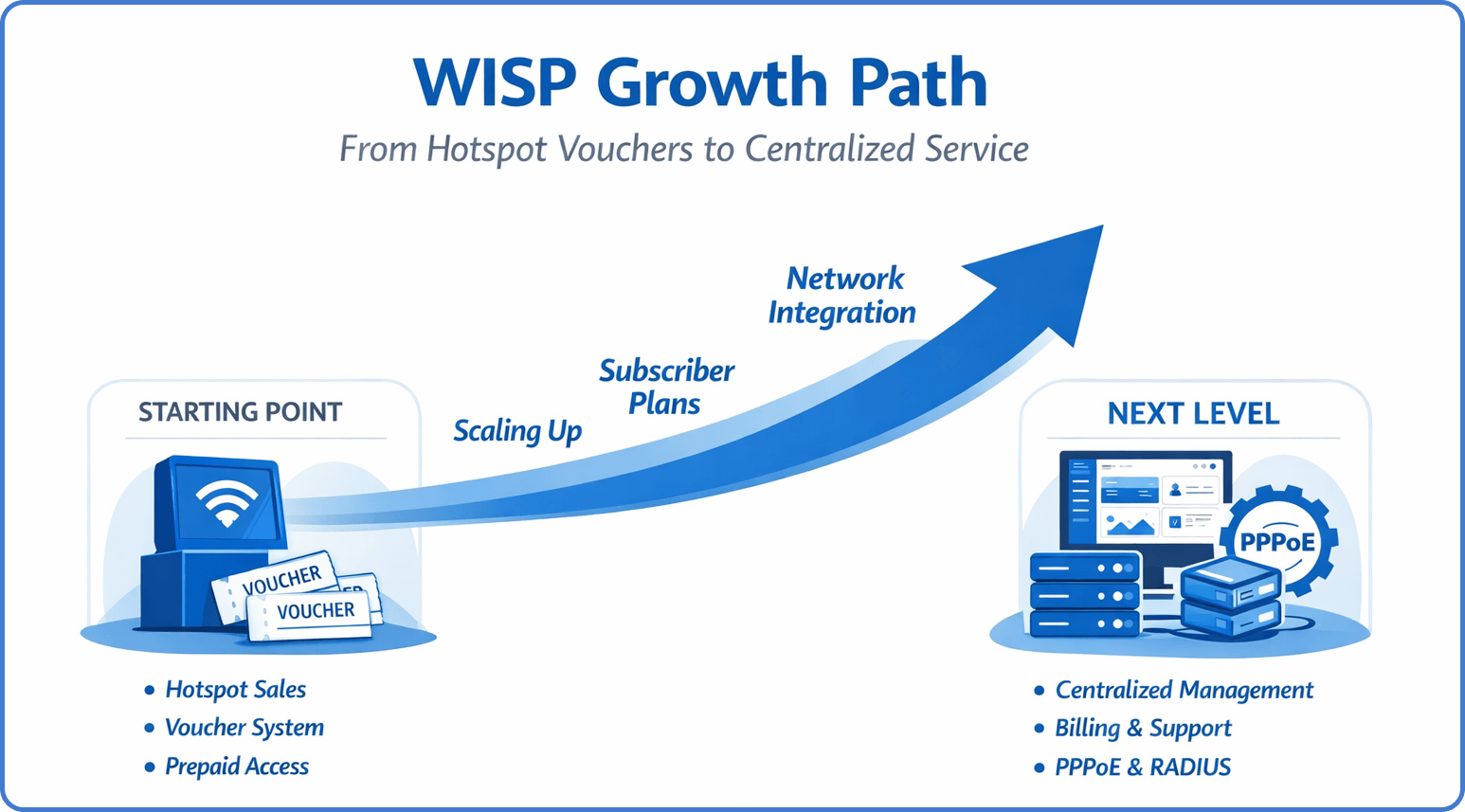
What should really be on a WISP radar?
Every WISP looks at tools through a practical lens.
Can this platform help me sell access? Can it reduce support work? Can it scale with my operation? Can it fit the way my network and business are evolving?
These are the questions that matter.
That is why comparing Wirenexfree and MKController can be useful, not as a fight between two names, but as a way to understand different stages of WISP maturity. In many cases, a provider is not simply choosing between two products. It is deciding what kind of operation it wants to build.
This matters because the WISP market is changing. Operators are expected to deliver stable connectivity, manage customer expectations, automate common tasks, and keep technical and commercial processes aligned. A solution that works well at the beginning may not be enough forever.
That does not make the simpler tool wrong. It just means each platform can play a different role depending on where the WISP is on its journey.
Why simple entry-point tools matter
It is important to be fair here.
Tools like Wirenexfree can make sense for operators that need a quick and simple way to begin monetizing access. A voucher-based model is easy to understand. It works well for hotspot environments, prepaid usage, temporary access, and controlled internet distribution in places such as events, guest networks, hospitality scenarios, and small community deployments.
That kind of simplicity has value.
In fact, many WISPs and local providers begin with exactly this kind of need. They are not looking for a full OSS/BSS on day one. They want something that helps them launch, test demand, and create a basic revenue flow without a heavy implementation process.
Seen from that perspective, Wirenexfree is easy to understand. It represents the kind of entry-point solution that helps operators take their first commercial steps in managed internet access, much like many lightweight tools in the market.
For early-stage operations, that can be enough.
The moment when the WISP radar gets wider
The challenge is that a WISP rarely stays in “entry-point mode” for long.
As the business grows, the radar expands. The operator starts thinking beyond voucher sales and temporary sessions. Questions become more operational and strategic.
How do we manage multiple sites consistently?
How do we organize permissions for different staff members?
How do we centralize visibility across routers and services?
How do we reduce manual processes?
How do we prepare for recurring subscriber plans instead of only temporary access?
This is the point where the comparison becomes more interesting.
Wirenexfree can illustrate the first stage well: simple monetization, basic access control, and a lower barrier to getting started. MKController starts to illustrate the next stage: broader management, more structure, and a clearer path toward bringing more of the WISP operation into one place.
That shift is not about attacking simpler tools. It is about recognizing that WISP needs evolve.
Hotspot monetization is useful, but it is not the whole operation
Voucher systems solve a real problem.
They help providers package internet access in a way that is easy to sell and easy to consume. For hotspot-based business models, they remain relevant. They are practical, fast to deploy, and often easier for non-technical teams to work with.
But a WISP eventually needs more than session-based monetization.
It needs customer continuity. It needs recurring service logic. It needs stronger relationships between user identity, service plan, authentication, support, and billing processes. It needs network operations and business operations to stop behaving like separate worlds.
This is where the idea of “WISP radar” becomes useful. A smart operator does not only ask what solves today’s problem. It also asks what prepares the business for tomorrow’s reality.
MKController fits that broader view well.
Because it is more than only a voucher platform, it can be seen as an evolution for providers that started with simpler access monetization and now need a more centralized approach. That positioning is valuable because many operators want a smoother transition between stages instead of rebuilding everything from scratch later.
Wirenexfree as a starting point, MKController as an evolution
This is probably the clearest way to frame the comparison.
Wirenexfree can be understood as a possible entry point for WISPs or local operators that want to launch hotspot monetization quickly. It belongs to a category of tools that remove friction at the beginning. They are approachable, direct, and well matched to simpler deployment models.
MKController, however, looks more like the platform an operator grows into.
That is because MKController already places monetization inside a wider management context. The conversation is not only about creating vouchers. It is also about centralization, operational visibility, administrative structure, and the ability to build a more complete service environment over time.
For a WISP, that difference is important.
A business can start with an easy tool, but eventually it wants fewer disconnected parts. It wants one ecosystem that can handle more of the real operation. That includes service organization, monitoring logic, access workflows, role delegation, and the long-term convergence of technical and commercial management.
That is exactly where MKController becomes appealing.
Why PPPoE changes the conversation
One of the clearest signs that a WISP is maturing is the shift from temporary access logic to subscriber logic.
This is where PPPoE enters the picture.
PPPoE is not just a technical detail. It reflects a different operating model. Instead of selling isolated sessions, the provider begins managing recurring services, stable subscriber authentication, service plans, lifecycle control, and closer alignment between the customer database and the network database.
That is a very different level of business maturity.
In this context, it is worth being clear: MKController’s PPPoE solution is being designed. It should not be treated as if everything were already fully delivered today. The important point is that this direction makes sense precisely because MKController is already broader than just vouchers.
That is why the platform feels like the right evolution.
A WISP that adopts MKController is not just choosing a way to monetize access now. It is moving toward a structure that can eventually bring together the wider set of capabilities a WISP needs in one place. That is the strategic value behind the roadmap.
Why “one place” matters for WISPs
WISPs often grow faster than their internal tools do.
At first, that seems manageable. A router here, a spreadsheet there, a billing workaround somewhere else, a support routine handled manually, and a hotspot tool filling one specific gap. For a while, it works.
Then the cracks appear.
Staff spend time moving between systems. Information gets duplicated. Provisioning becomes inconsistent. Support takes longer than it should. Reporting loses accuracy. Scaling becomes more tiring than exciting.
That is why platform consolidation matters.
MKController presents a stronger long-term vision because it is closer to the idea of a single operational environment. Even before PPPoE capabilities fully mature, the logic is already there: bring important workflows together, reduce fragmentation, and give the operator a clearer management layer.
For a WISP, that is not just a convenience feature. It is a growth advantage.
A practical way to read this comparison
So how should operators read a comparison between Wirenexfree and MKController?
A balanced answer would be this:
If the current need is straightforward hotspot monetization with low complexity, a tool like Wirenexfree can be a sensible starting point. It represents a practical entry into access sales and can help validate the first stage of a business model.
If the operator is looking beyond the first stage, MKController becomes more interesting. It reflects a broader understanding of what a WISP eventually needs: centralized operations, better structure, and a platform that can evolve toward a more complete service stack.
This framing is more useful than a feature war.
It respects the role of simpler tools while also recognizing that many WISPs are not trying to stay simple forever. They are trying to build sustainable operations.
That is where MKController stands out most.
Final take
A healthy WISP radar should track more than trends, keywords, or whatever tool is getting the most immediate attention.
It should track fit.
Wirenexfree is useful to illustrate the kind of entry-point solution that helps operators begin with hotspot monetization. That role is valid, practical, and relevant in many scenarios.
MKController represents the next step in that journey.
Because it is more than just vouchers, it is better aligned with what growing WISPs usually need next: more control, more centralization, more operational consistency, and a clearer path toward bringing essential capabilities together in one place. That includes the PPPoE direction now being designed as part of a broader vision.
For WISPs that want to start smart and grow without fragmenting the business, that is a very strong position.
For more context, explore the MKController documentation hub and MikroTik’s official references for PPPoE and RADIUS integration.
About MKController
Hope the insights above helped you navigate your MikroTik and Internet universe a little better! 🚀
Whether you’re fine-tuning configs or just trying to bring some order to the network madness, MKController is here to make your life simpler.
With centralized cloud management, automated security updates, and a dashboard that anyone can master, we’ve got what it takes to upgrade your operation.
👉 Start your free 3-day trial now at mkcontroller.com — and see what effortless network control really looks like.